
The stone choice for a dry-stack garden wall affects construction time, structural performance, long-term maintenance, and how the finished wall sits in its landscape. Canada's geology produces a wide range of usable stone types, with significant regional differences in what is locally available and at what cost. The alternative to natural stone—manufactured concrete retaining wall blocks—offers different trade-offs around uniformity and ease of construction.
Fieldstone: Definition and Availability
Fieldstone is stone that has been moved by glacial activity and deposited on or near the surface of agricultural or forested land. In Canada, the Laurentian Shield provided the source material, and retreating glaciers distributed it across southern Ontario, Quebec, the Maritimes, and parts of the Prairie provinces. Farmers clearing land have historically piled or sold this stone, making it available at low cost from rural suppliers, stone yards, and occasionally directly from agricultural operations.
The defining characteristic of fieldstone is its irregular shape. Glacial transport rounds edges and faces to varying degrees, so fieldstone ranges from roughly blocky pieces with flat faces to nearly spherical rounded stones with no flat surfaces at all. Rounded fieldstone makes a structurally weaker dry-stack wall because bearing surfaces are limited. Flat-faced fieldstone—often called flag fieldstone or slab fieldstone—courses well and produces stable walls.

Quarried Stone Options in Canada
Quarried stone is cut or split from bedrock. It is more uniform than fieldstone, arrives in more predictable sizing, and typically has at least one flat face. Several types are quarried in Canadian provinces and commonly used for garden walls.
Limestone
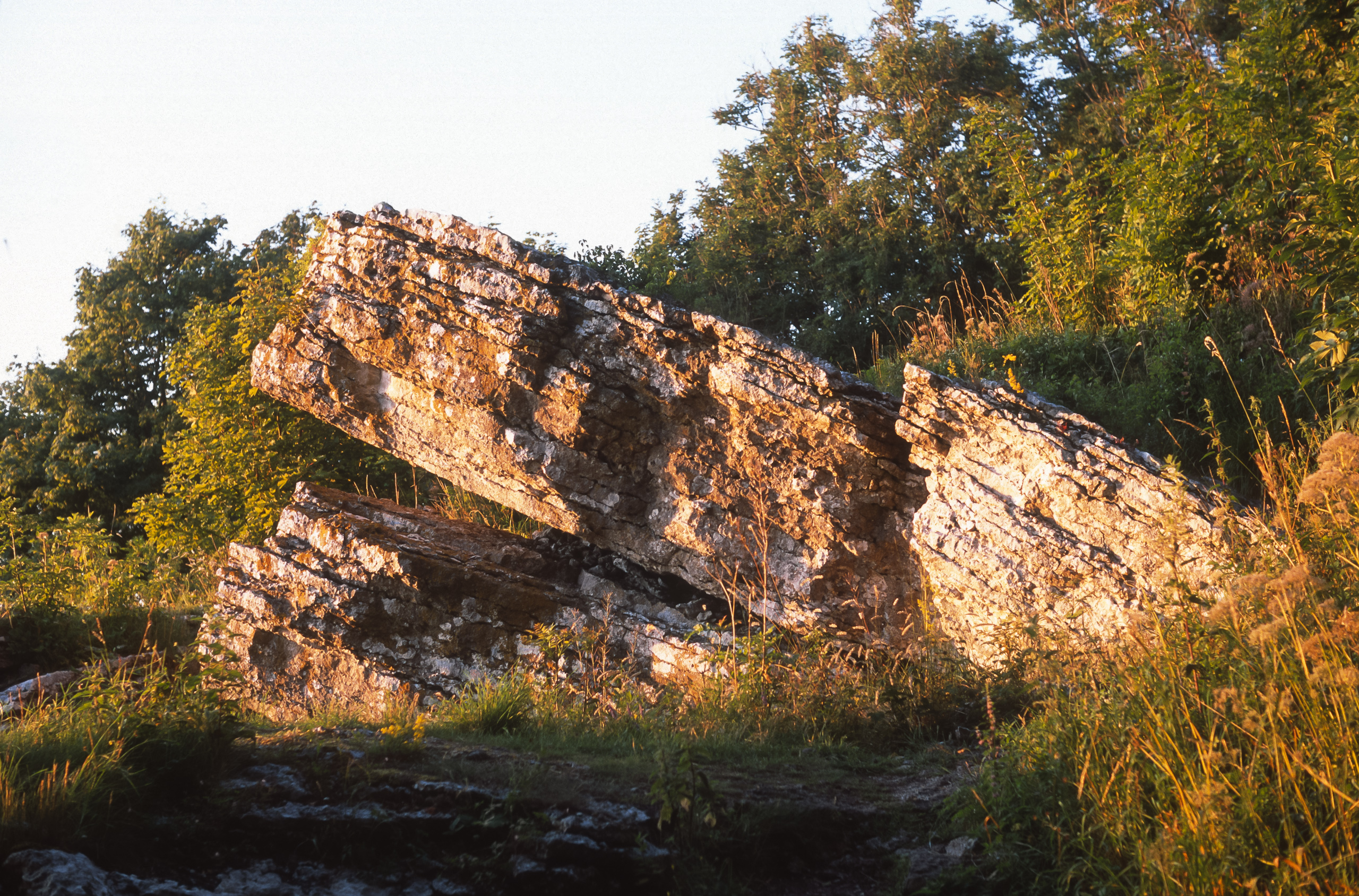
Limestone is quarried extensively in Ontario (the Niagara Escarpment region, Bruce Peninsula, and eastern Ontario near Kingston) and in Manitoba. It splits relatively cleanly along bedding planes, producing flat slabs and blocks with natural faces. Its warm grey-beige colour is a common landscape aesthetic in southern Ontario. Limestone is softer than granite and more susceptible to surface weathering over decades; the Niagara Escarpment formation produces harder varieties that hold up better in freeze-thaw conditions.
Granite
Granite is the dominant rock of the Canadian Shield and is quarried in Ontario, Quebec, and BC. It is significantly harder than limestone, more resistant to freeze-thaw degradation, and heavier per unit volume. Cut granite for wall use is typically available as split-face or sawn blocks. Rough split granite has a texture that grips well in dry-stack construction. Its higher density—roughly 2700 kg/m³ versus limestone at around 2300 kg/m³—means a granite wall of equal dimensions weighs more and resists soil pressure better per course, though it is also harder to handle manually.

Sandstone
Sandstone is available in parts of Alberta, Nova Scotia, and BC. It is layered and splits into flat slabs that course well. Sandstone varies considerably in hardness and durability depending on the degree of cementation between sand grains; softer varieties spall readily through freeze-thaw action, while harder quartzite-like sandstones are quite durable. The warm ochre and reddish tones of Nova Scotia sandstone are distinctive; Alberta sandstone tends toward buff-grey.

Manufactured Concrete Retaining Wall Blocks
Segmental retaining wall blocks—manufactured concrete units with a textured face—are the other side of the stone selection decision. They are produced by multiple manufacturers across Canada and are widely available at building supply stores. Common brands use interlocking geometry with a rear lip that sets the batter angle automatically. Each block is identical in weight and dimension, making layout calculation and ordering straightforward.
| Material | Shape Uniformity | Frost Resistance | Regional Availability | Relative Cost |
|---|---|---|---|---|
| Fieldstone (flat-faced) | Variable | Moderate–High (varies) | Ontario, Quebec, Maritimes | Low to moderate |
| Quarried limestone | Moderate | Moderate | Ontario, Manitoba | Moderate |
| Quarried granite | Moderate–High | High | Ontario, Quebec, BC | Moderate–High |
| Sandstone | Moderate | Low–Moderate | Alberta, Nova Scotia, BC | Moderate |
| Concrete retaining blocks | High (uniform) | High (engineered) | Nationwide | Moderate |
Structural Comparison
Flat-faced fieldstone and quarried stone require skill to lay well because each stone is unique. Good dry-stack construction involves selecting and fitting each piece individually, minimizing voids, and avoiding continuous vertical joints that run through multiple courses. This is time-intensive but produces a wall with excellent stone-to-stone friction because adjacent faces are fitted closely.
Concrete retaining blocks are engineered for consistent bearing. The batter is built into the block geometry; drainage holes are often cast in. Installation is faster and requires less skill to achieve a structurally sound result. The aesthetic is more uniform, which suits some contexts and looks out of place in others.
Regional Considerations
In Ontario's Georgian Bay and Muskoka region, local granite fieldstone is abundant and inexpensive from rural sources. Limestone from the Escarpment is more common in Hamilton, Burlington, and the Niagara Peninsula. In Quebec's Eastern Townships, local granite and some imported limestone coexist. In BC's Lower Mainland, basalt and granite are available but transportation costs from quarry sources add to pricing. In the Prairie provinces, limestone from Manitoba quarries is one of the few locally available stone options; fieldstone is less common than in the Shield regions.
Sourcing note: Before purchasing stone, checking local classifieds, farm supply contacts, and demolition salvage is worthwhile in rural Ontario and Quebec. Salvage stone from old field walls or building foundations is available at reduced cost and is already weathered to local conditions.
Mixing Stone Types
A practical approach in many builds is to use a mix: large flat fieldstone for the base courses where stability matters most, quarried limestone or granite for mid-wall coursing where flat faces improve bedding, and selected larger capstones of quarried stone for the top course where appearance and weather exposure are highest. This pragmatic mixing is common in older Canadian rural construction and is structurally sound as long as each course is laid for maximum bearing contact.